192.168.8.1 — Huawei Mobile WiFi Admin
The address 192.168.8.1 belongs to Huawei's world of mobile internet devices. If you've got a Huawei pocket MiFi, a 4G home router, or one of their 5G CPE units, this is how you get into the settings. Unlike home broadband routers that use addresses like 192.168.1.1, Huawei carved out this distinct IP range specifically for their cellular devices — so if you're seeing this address, you're dealing with a SIM-card-powered device.
Which Devices Use 192.168.8.1?
Almost every Huawei cellular device uses this address. Here's a breakdown by category:
Pocket MiFi Hotspots
These are the small, battery-powered units you carry in your pocket or bag. Pop in a SIM card, press the power button, and you've got Wi-Fi for up to 10-16 devices. Popular models include the E5577, E5785, and the E5576. They're commonly sold by carriers worldwide or unlocked online.
4G Home Routers (CPE)
Designed to sit on a desk or windowsill, these are full-size routers that use a SIM card instead of a landline. The B311 and B315 are entry-level units. The B525 and B535 are mid-range with better antenna support and LAN ports. If you're in a rural area without fiber or cable, these are often the best option.
5G CPE Routers
The newer generation. The H122-373 (5G CPE Pro 2) and H155-381 deliver fixed wireless broadband over 5G. They're faster than most 4G home connections and increasingly offered by carriers as an alternative to wired broadband. Same admin address — 192.168.8.1.
| Model | Type | Max Speed | Wi-Fi Devices |
|---|---|---|---|
| E5577 | Pocket MiFi | 150 Mbps | 10 |
| E5785 | Pocket MiFi | 300 Mbps | 16 |
| B311-221 | 4G Home Router | 150 Mbps | 32 |
| B525s-65a | 4G Home Router | 300 Mbps | 64 |
| B535-232 | 4G Home Router | 400 Mbps | 64 |
| H122-373 | 5G CPE | 3.6 Gbps | 128 |
Logging In for the First Time
- Power on your Huawei device and wait for it to connect to the cellular network (the signal indicator should show bars)
- Connect to its Wi-Fi — the default SSID and password are on a card inside the box, or printed on the device itself
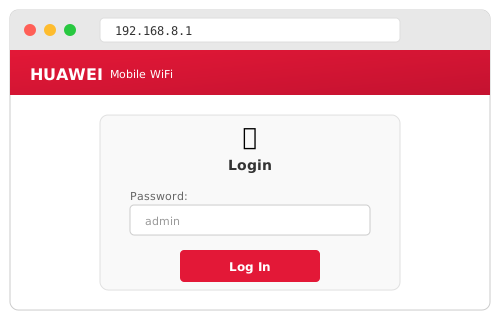
- Open any browser and go to
http://192.168.8.1 - Enter the admin password — on older models it's just
admin. Newer models have a unique password on the device label
On your very first login, some devices will prompt you to change the default password. Do this — especially if you're using the device in public places like cafés or airports.
Changing the Wi-Fi Password
This is the most common reason people log into 192.168.8.1. The default Wi-Fi password is often a random string that's annoying to type, especially when connecting friends' phones:
- Login at
192.168.8.1 - Go to Settings → WLAN (or Wi-Fi Settings on some firmware versions)
- Change the SSID (network name) to something you'll recognize
- Change the WPA Pre-Shared Key (password) to something memorable but secure
- Set security to WPA2-PSK — never leave it open or on WEP
- Save and reconnect your devices with the new password
APN Settings — Getting Your SIM Online
If you've inserted a SIM card but have no internet, the APN (Access Point Name) probably needs configuring. This tells the device how to connect to your carrier's data network.
- Login at
192.168.8.1 - Go to Settings → Dial-up → Profile Management
- Click New Profile
- Enter your carrier's APN details (Google "[your carrier] APN settings" to find these)
- Save and restart the device
Monitoring Data Usage
Since these devices run on mobile data, keeping track of usage matters — especially on capped plans. The admin panel at 192.168.8.1 has a built-in data counter:
- The home screen shows current session data (upload/download)
- Under Statistics, you can see monthly totals
- You can set a data limit that will cut off the connection when reached — preventing surprise overage charges
- Some models show per-device usage, so you can see which connected device is consuming the most data
SMS from Your Browser
One underappreciated feature: Huawei's admin panel lets you read and send SMS messages from the SIM card directly in your browser. Go to SMS → Inbox at 192.168.8.1. This is surprisingly useful for:
- Reading carrier notifications about your balance or data top-ups
- Receiving verification codes when the SIM is in the MiFi, not your phone
- Managing prepaid recharges via SMS commands
When 192.168.8.1 Won't Open
You're connected to the wrong Wi-Fi. This is the most common issue. You need to be connected to the Huawei device's own Wi-Fi network, not your home router. Check your phone or laptop's Wi-Fi connection — it should show the Huawei SSID.
The device isn't fully booted. Pocket MiFis and 4G routers need 30-60 seconds after powering on before the admin panel becomes accessible. Wait for the Wi-Fi indicator to stabilize.
Battery is too low. Pocket MiFi devices sometimes refuse connections when the battery is critically low. Plug in the USB charger and try again.
Too many devices connected. Budget MiFi units can struggle when they're at device capacity. Disconnect a few devices, then try the admin page.
Forgotten admin password. If you changed the admin password from admin to something else and forgot it, you'll need to factory reset. On pocket MiFis, there's a tiny reset pinhole — press and hold with a paperclip for 5-10 seconds while the device is on. This wipes all custom settings including Wi-Fi password and APN.
Huawei AI Life App
Huawei also offers the Huawei AI Life app (formerly HiLink) for managing these devices from your phone. It gives you most of the same features as the web interface — Wi-Fi settings, data monitoring, connected devices — in a mobile-friendly layout. Available on both iOS and Android, and on Huawei's AppGallery.
The app can also manage multiple Huawei networking devices if you have more than one, and it supports firmware updates over the air.